
- Share the positive experience of our cooperation and recommend us to your friends and acquaintances:


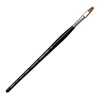
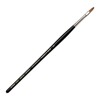
Size 4 of the MAESTRO Series 1301 is the mid-size flat in Tobolsky Kolinsky sable: 10.0 mm of hair in a 4.5 mm width. It is the tool for surfaces that are already too big for a round brush – a cloak, a wing, a horse's flank, a vehicle panel or the whole armour of a 54 mm or 75 mm figure.
Compared with size 2 it has a millimetre more hair and almost twice the width. It carries more thinned paint, and one stroke covers a band that would take three with the small brush. With glazes and wet blending that is what matters: fewer strokes mean fewer edges for a drying layer to leave behind.
Specifications
| Series | 1301 (MAESTRO) |
| Size | 4 |
| Hair / fibre | Tobolsky Kolinsky red sable from male winter tails |
| Shape | flat |
| Visible hair length | 10.0 mm |
| Brush width | 4.5 mm |
| Total length | 190 mm |
| Handle | short wooden, black lacquered |
| Ferrule | silver-coloured |
| Paints | watercolour, gouache, thinned acrylics |
| Manufacturer | da Vinci Kunstlerpinselfabrik DEFET GmbH, Nuremberg |
| Country of origin | Germany |
| Manufacturer code | VA-1301_4 |
What it does on a miniature
- Cloaks and fabric – A wide band of glaze along the full length of a fold. The flat sable lays the paint down evenly and the fold does not turn blotchy.
- Wet blending over a large area – Two layers side by side while they are wet, then one flat stroke across the boundary. Sable stays wet longer than synthetic fibre, so you get more working time.
- Vehicle panels and large plates – On tanks, mechs and ships it covers a panel without stripes. Turned on its edge, it gives a straight edge highlight along a longer edge too.
- Zenithal light on larger figures – On 54–75 mm figures and monsters it models light and shadow across shoulders and wings with bigger strokes.
Size 4 or size 2?
Size 2 (2.7 mm) is for 28–32 mm figures and detail on flat surfaces. Size 4 is for areas where the small brush would need many strokes side by side. If you paint mostly infantry, start with the 2; if you paint vehicles, monsters or larger scales, the 4 does more of the work.
For busts and very large surfaces there is size 6. If you need a soft transition with no edge at the end of the stroke, reach for the NOVA 1375 size 2 filbert – it is synthetic, cheaper, and its rounded tip leaves no hard edge.
FAQ
What scales is size 4 for?
On 28 mm figures only for larger areas such as cloaks, wings and bases. It comes into its own on 54 mm and 75 mm figures, monsters, vehicles and smaller-scale busts.
Can I drybrush with it?
No, and we advise against it. Dry scrubbing over edges destroys sable hair and the brush loses its straight edge. Use the synthetic DRY BRUSH 140 for that.
How is it different from a synthetic flat?
Synthetic fibre is stiffer and cheaper, but releases paint less evenly – with a glaze that tends to show as stripes. Sable is softer, holds more paint and gives a smoother stroke. Use synthetic for metallics, washes and texture pastes, sable for paint that has to look good.
How do I keep the edge straight?
After painting, wash it in lukewarm water with 4033 brush soap, draw the hair into a straight edge between your fingers and dry it flat or hair up. Never leave it standing in the water pot – the hair bends and the edge splits.
Not sure which series fits your work? The complete guide to da Vinci brushes for miniatures compares every series by hair length, shape and use.
- price23.60 €
- price17.50 €
- price15.40 €
KontaktContact
Dark Rose Miniatures
Moment, s.r.o.
Murgašova 688/15
957 01 Bánovce nad Bebravou
SlovenskoSlovakia
+421 905 526 450
info@darkroseminiatures.com
IČOCompany ID: 45 469 199 · DIČTax ID: 2023002531
Zapísaná v OR Okresného súdu Trenčín, oddiel Sro, vložka č. 22783/RRegistered in the Business Register of the District Court Trenčín, section Sro, file no. 22783/R
InformácieInformation
Sledujte maFollow me
Instagram Facebook YouTube TikTokVymaľované figúrky, návody a novinky skladom.Painted miniatures, tutorials and new stock.
Platba a dopravaPayment and shipping


 Packeta
Karta (CardPay), PayPal, bankový prevod, dobierka.
Packeta – SK, CZ, HU, PL, RO.
Doprava na Slovensko zdarma nad 60 €.
Card (CardPay), PayPal, bank transfer, cash on delivery.
Packeta – SK, CZ, HU, PL, RO.
Free shipping within Slovakia over €60.