
 |
 |  |  |  |  |
 |  |  |
- Share the positive experience of our cooperation and recommend us to your friends and acquaintances:


Primers
Primer is the dull product that decides whether a model survives. Acrylic paint will not hold on smooth plastic, resin or metal – it lifts at the first firm touch or when masking comes off. Primer is formulated to bond to the substrate and to give paint something to grip. Its second, less discussed job is to unify the surface. A model built from plastic, resin and photo-etch comes out of priming with one colour and one texture, so paint shades sit the same way everywhere on it.
What is in the category
| Bottles, 100 ml | 3rd Generation self-levelling primers – black, grey and white, airbrush-ready as supplied |
| Sprays, 400 ml | Fine Primer in black, grey and white, with two diffusers in the can |
Which colour of primer to choose
Grey is the safe choice – it does not shift the shade of the paint over it and suits almost everything. Black is the base for metallics and for anything meant to read dark; building up from black with zenithal lighting works well. White lifts the saturation of yellow, orange, red and bright shades that would need three coats over a dark ground instead of one.
Bottle or spray is a question of speed against precision. A spray covers a large model or a batch of parts in a minute, with less control over film thickness. An airbrush lays a thinner, more precise coat, which pays off on small figures and fine detail.
Frequently asked questions
Can primer be skipped?
On plastic that will not be masked or handled much, you may get away with it. On resin, metal and photo-etch you will not – there the paint lifts without primer, even if it does not show at first.
How thick should the coat be?
Thin. Primer is there to colour the substrate, not to flood it. The first coat should be thin enough that the material still shows through – engraved lines and rivets must stay readable.
When can painting start?
After an hour without trouble. For sanding and mechanical stress allow 24 hours; the layer is still hardening until then.
What comes next?
Paints from the AK 3rd Generation range, thinning and cleaning from Thinners and Cleaners, and a finish from Varnishes.
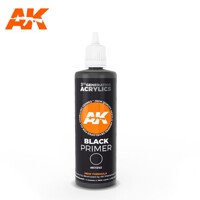
- AK Black Primer 3rd Generation, 100 ml
- 6.60 €price
- Availabilityout of stock
- Acrylic self-levelling primer in black, 100 ml. Airbrush-ready, non-toxic, sandable after 24 hours.
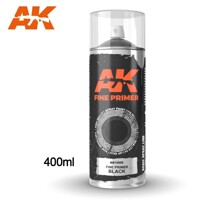
- AK Fine Primer Black Spray, 400 ml
- 10.95 €price
- Availabilityavailable
- Fine spray primer in black, 400 ml. Two diffusers included, holds on plastic and metal.
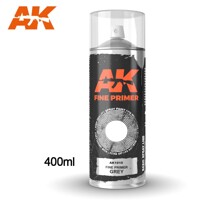
- AK Fine Primer Grey Spray, 400 ml
- 10.95 €price
- Availabilityavailable
- Fine spray primer in grey, 400 ml. Two diffusers included, holds on plastic and metal.
- AK Fine Primer White Spray, 400 ml
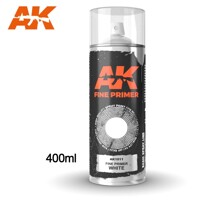
- 10.95 €price
- Availabilityavailable
- Fine spray primer in white, 400 ml. Two diffusers included, holds on plastic and metal.
- AK Grey Primer 3rd Generation, 100 ml
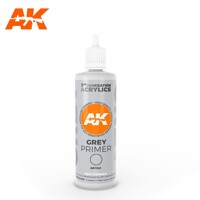
- 6.60 €price
- Availabilityout of stock
- Acrylic self-levelling primer in grey, 100 ml. Airbrush-ready, non-toxic, sandable after 24 hours.
- AK White Primer 3rd Generation, 100 ml
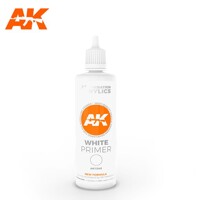
- 6.60 €price
- Availabilityout of stock
- Acrylic self-levelling primer in white, 100 ml. Airbrush-ready, non-toxic, sandable after 24 hours.