
 |
 |  |  |  |  |
 |  |  |
- Share the positive experience of our cooperation and recommend us to your friends and acquaintances:


Textures
AK Interactive textures and pastes are the materials that turn a bare base into a scene. They are not paints – they are compounds with volume, grain and sheen, applied with a spatula or an old brush, that cure into a surface no brushwork can imitate. The range covers the whole road from groundwork to the last detail: soil, sand, mud, water, ice, snow, corrosion and moss.
How the range is organised
| Water & ice | gels, self-levelling liquids and two-part resins for surfaces, waves, puddles and ice floes |
| Terrain textures | finished soil and sand shades plus neutral pastes you tint to your own colour |
| Snow & ice | thick paste for continuous cover, fine texture for fresh dusting and loose powder for thawing snow |
| Mud & splatter | the materials for what sticks to a vehicle – wet and dry splatter, build-up inside fenders |
| Crackle effects | products that crack as they dry; layer thickness controls the size of the cracks |
| Others | corrosion, moss and an alcohol-based fixer for loose materials |
How to choose
The method is nearly always the same and three products cover it. Groundwork – a soil or sand paste that gives the surface its shape and tone; wheel, track and boot marks are pressed into it while wet. The effect – what gives the scene its story: a puddle in a rut, snow on the edges, rust on a panel, moss in the shade. Fixing and finishing – pigments, spot gloss varnish and fixer for anything loose.
If you are starting out, buy one ground paste to suit the scene you are building and add Puddles. Those two cover most bases. Water gels and resins earn their place once the scene actually has water in it.
FAQ
Are AK textures compatible with other brands?
Yes. They are water-based acrylic materials, so they combine with acrylic paints, washes and pigments from any maker. The only exception is the two-part epoxy resins, which mix only with themselves.
How many products does one base need?
For a 25 mm to 40 mm base, one ground paste and one effect is enough. The 100 ml and 250 ml pots are large by modelling standards – 250 ml of paste covers dozens of bases.
How should textures be stored?
Close the pot firmly after use and store at room temperature. Acrylic pastes do not survive freezing – once frozen they separate and will not recombine. Clean dried material off the rim or the lid will stop sealing.
More diorama materials are in the Pigments, Vegetation and Building Materials categories.
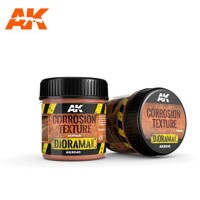
- AK Corrosion Texture 100 ml
- NOVINKA
- -2%
- 8.50 €standard price8.30 €price
- Availabilityavailable
- Acrylic texture for surface corrosion and rust on vehicles and dioramas. 100 ml, thin layer plus pigments.
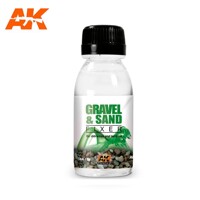
- AK Gravel and Sand Fixer 100 ml
- NOVINKA
- -3%
- 5.90 €standard price5.70 €price
- Availabilityavailable
- Alcohol-based fixer for sand, gravel, stones and static grass. 100 ml, leaves no plastic sheen, cleans with alcohol.
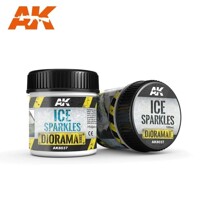
- AK Ice Sparkles 100 ml
- 6.90 €price
- Availabilityavailable
- Sparkling texture for icy snow, thaw and broken glass. 100 ml, fixed with glue, varnish or a fixer.
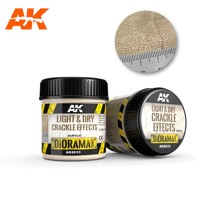
- AK Light and Dry Crackle Effects 100 ml
- -2%
- 8.50 €standard price8.30 €price
- Availabilityavailable
- Acrylic product for dry, cracked ground. 100 ml, crack size is controlled by layer thickness.
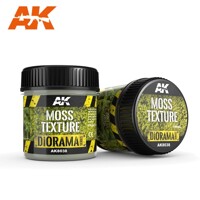
- AK Moss Texture 100 ml
- NOVINKA
- 5.95 €price
- Availabilityavailable
- Coloured ground foam for moss in forests, damp places and on abandoned vehicles. 100 ml.
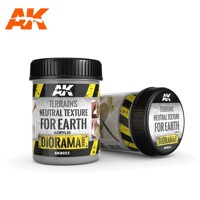
- AK Neutral Texture for Earth 250 ml
- -4%
- 8.95 €standard price8.60 €price
- Availabilityavailable
- Neutral white texture paste for earth that you tint with acrylics to your own shade. 250 ml, base product.
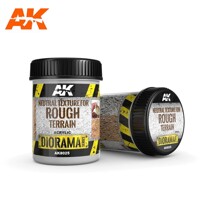
- AK Neutral Texture for Rough Terrain 250 ml
- -4%
- 8.95 €standard price8.60 €price
- Availabilityout of stock
- Coarse neutral paste for rocky, broken ground. 250 ml, tinted with acrylics, a base product for your own shades.
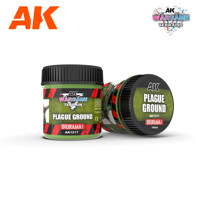
- AK Plague Ground Wargame Terrains 100 ml
- 6.95 €price
- Availabilityavailable
- Greenish Wargame Terrains texture for blighted, rotting ground. 100 ml, for fantasy and sci-fi bases.
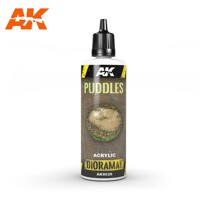
- AK Puddles 60 ml
- -1%
- 5.60 €standard price5.50 €price
- Availabilityavailable
- Lightly tinted self-levelling liquid for small puddles and dirty standing water. 60 ml, layers up to 3 mm.
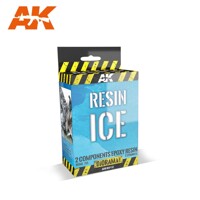
- AK Resin Ice Kit 150 ml
- 22.00 €price
- Availabilityavailable
- Two-part kit for making ice and ice floes. 120 ml resin, 30 ml hardener, 17 ml surface texture, two syringes.
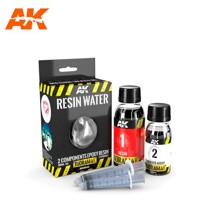
- AK Resin Water Two-Component Epoxy 180 ml
- 22.00 €price
- Availabilityout of stock
- Two-part epoxy resin for deep, crystal clear water. 180 ml, 2:1 mix, no shrinkage, no bubbles, two syringes included.
- AK Resin Water Two-Component Epoxy 375 ml
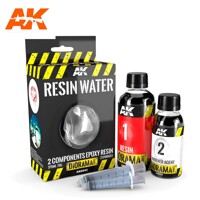
- 30.00 €price
- Availabilityout of stock
- Large pack of two-part epoxy resin for deep water. 375 ml, 2:1 mix, no shrinkage and no bubbles.